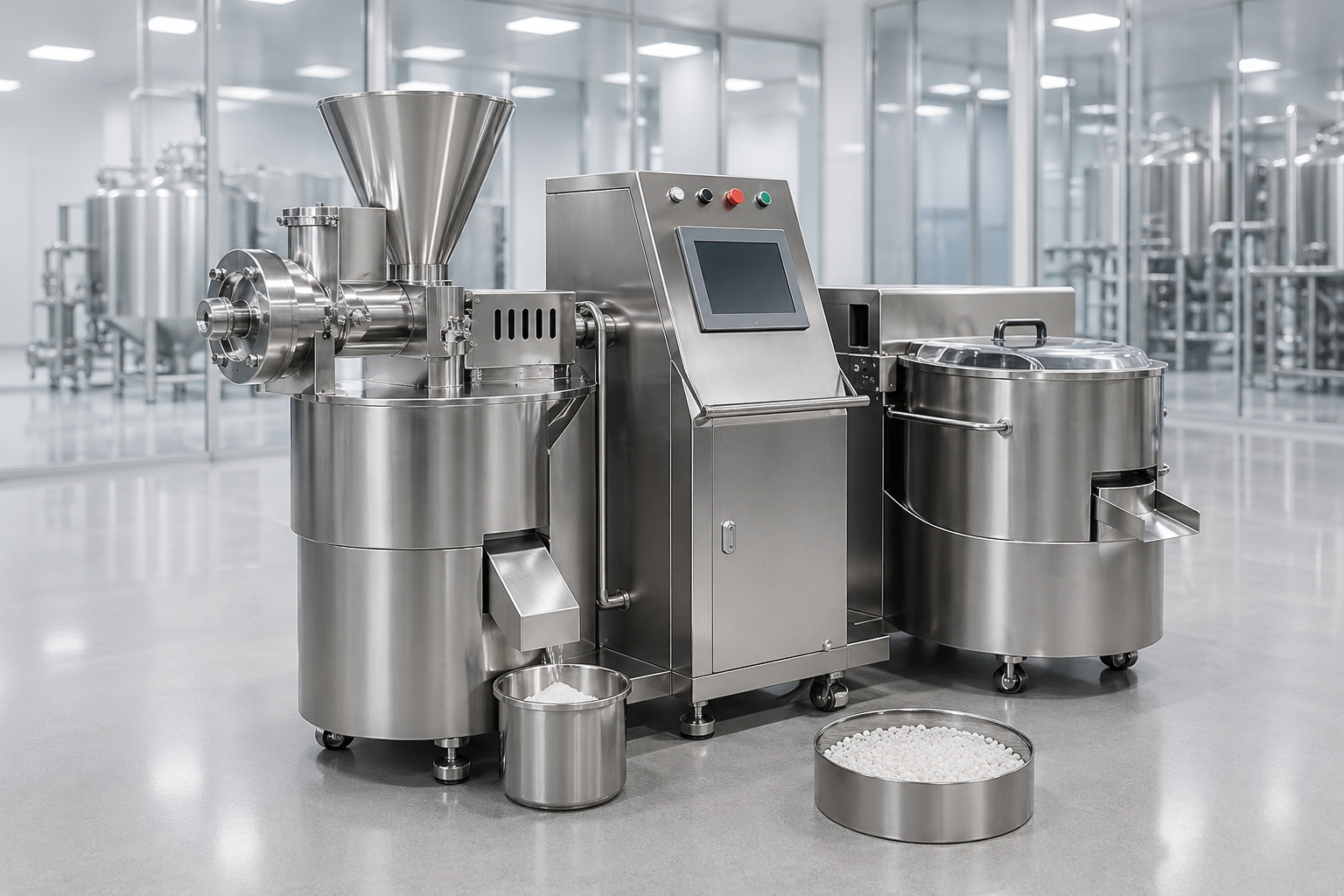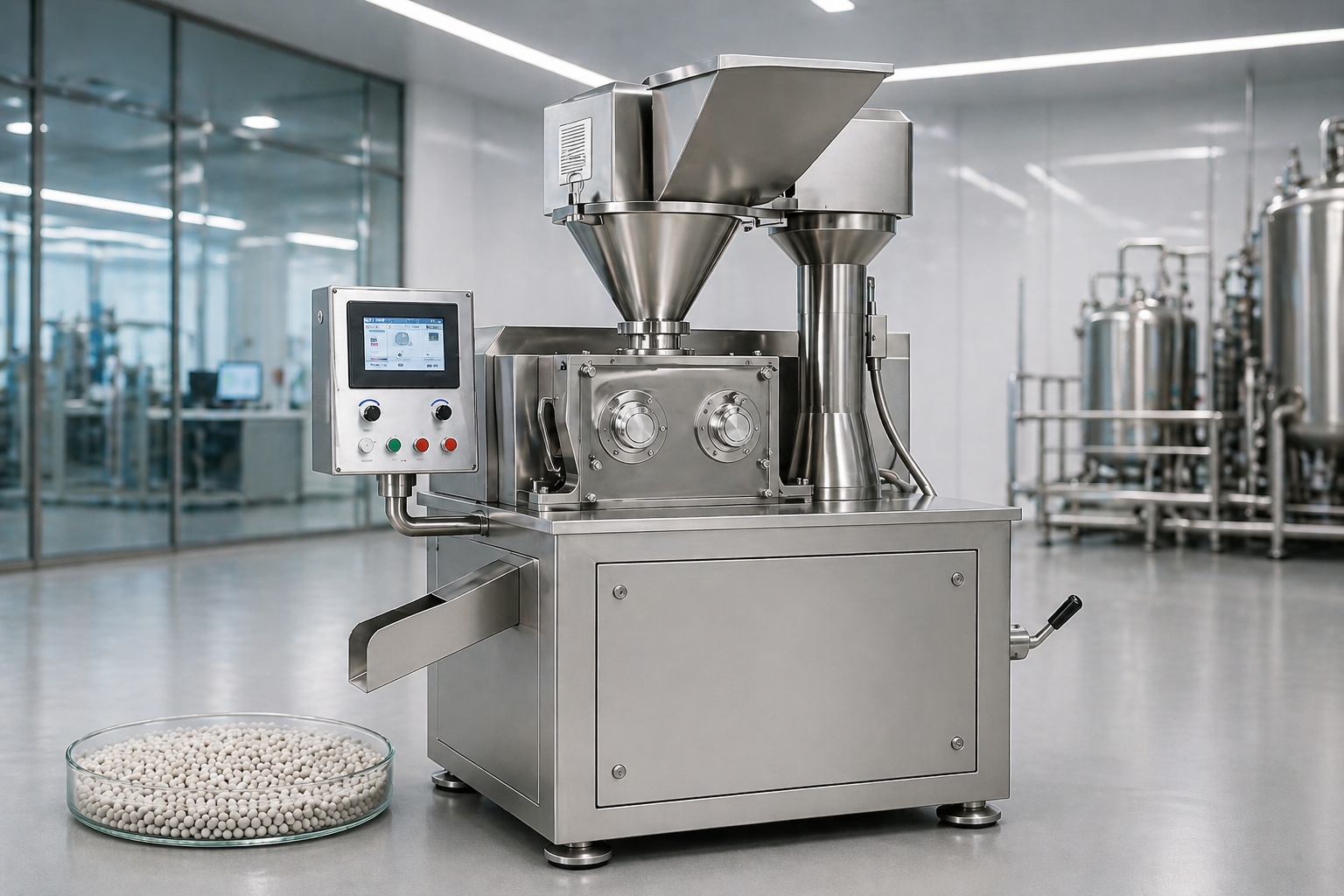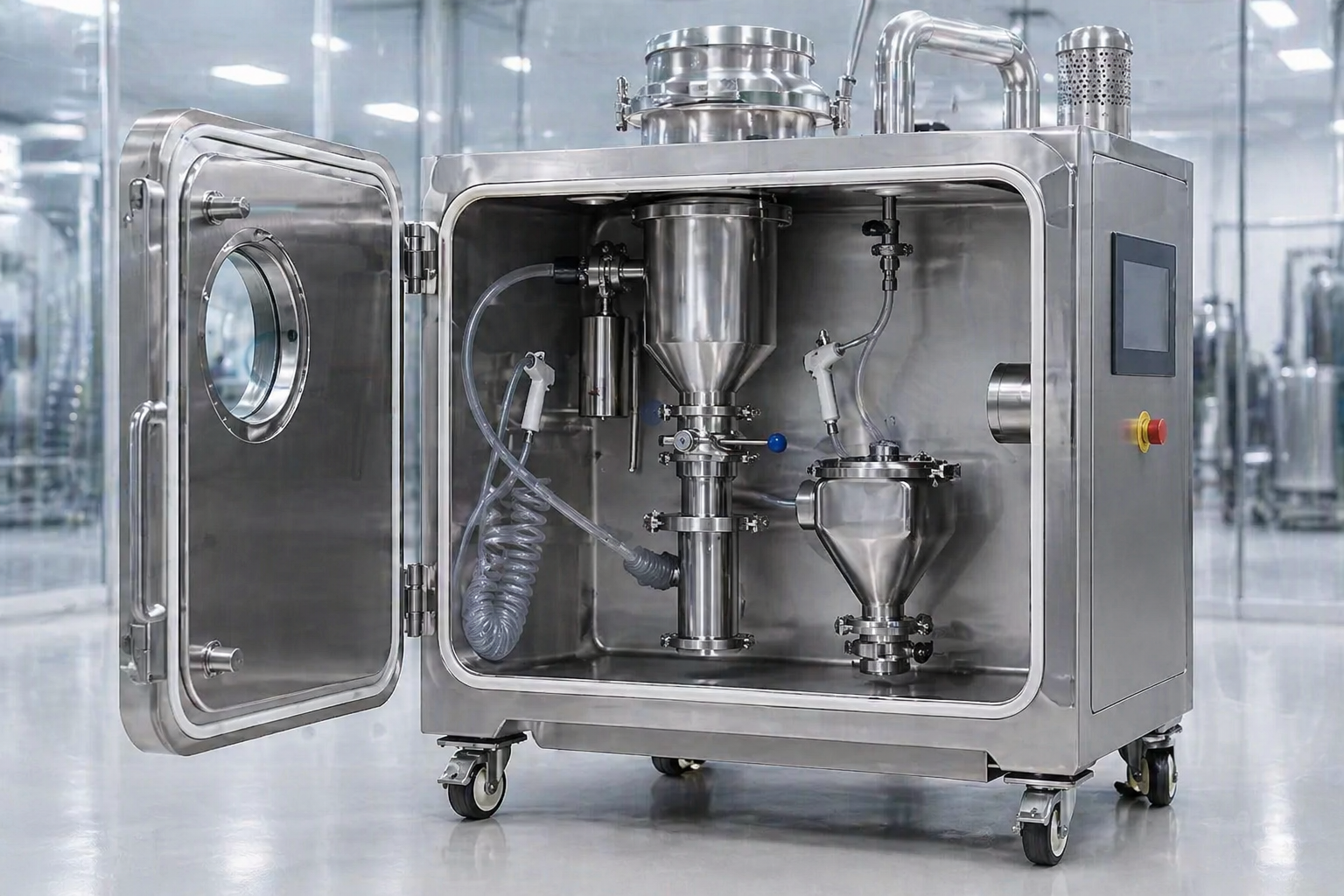
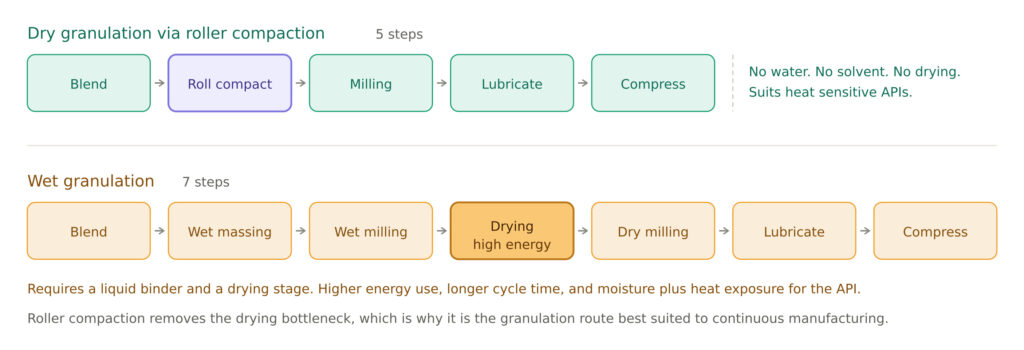
A pharmaceutical roller compactor is a dry granulation machine that converts a loose powder blend into dense, free-flowing granules by compressing it between two counter-rotating rolls. The compressed material exits as a ribbon, which is then milled into granules of a controlled particle size. Because no water, solvent, binder solution or drying step is involved, roller compaction is the default granulation route for moisture-sensitive and heat-sensitive active pharmaceutical ingredients.
What is a roller compactor in the pharmaceutical industry?
A roller compactor is the central piece of equipment in dry granulation, one of the three primary routes to producing an oral solid dosage form. The other two are direct compression, where powder goes straight to the tablet press, and wet granulation, where a liquid binder agglomerates the powder before it is dried.
Roller compaction sits between those two. It solves the flow and density problems that make direct compression unworkable for many blends, without introducing the moisture and heat that make wet granulation unsuitable for sensitive molecules.
The machine performs four functions in sequence:
- Meters the powder blend at a controlled rate into the compaction zone
- De-aerates the powder so trapped air does not disrupt densification
- Compresses the powder between rolls into a continuous ribbon or flake
- Mills that ribbon into granules within a defined particle size distribution
Everything downstream, tablet hardness, content uniformity, dissolution, capsule fill weight, is shaped by how well those four functions are controlled.
How does a pharmaceutical roller compactor work?
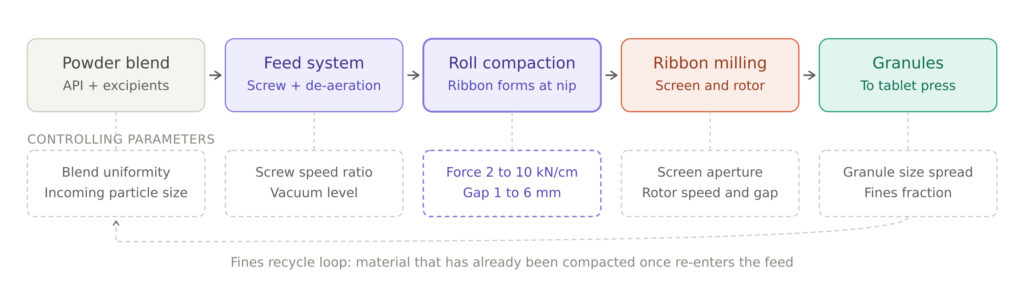
Stage 1: Feeding and de-aeration
Powder enters a hopper and is transported to the rolls by a feed screw. Most pharmaceutical units use a two-screw arrangement: a horizontal or angular conveying screw that moves material across, and a vertical tamping screw that pre-densifies it and pushes it toward the nip.
Fine, cohesive powders carry a large volume of entrained air. If that air is not removed it escapes at the nip and disrupts ribbon formation, producing weak, porous, or split ribbons. This is why most production-scale compactors include vacuum de-aeration on the feed system. Feed screw speed is not a background setting. It directly determines how much material reaches the nip, and therefore the pressure the rolls actually develop.
Stage 2: The nip zone
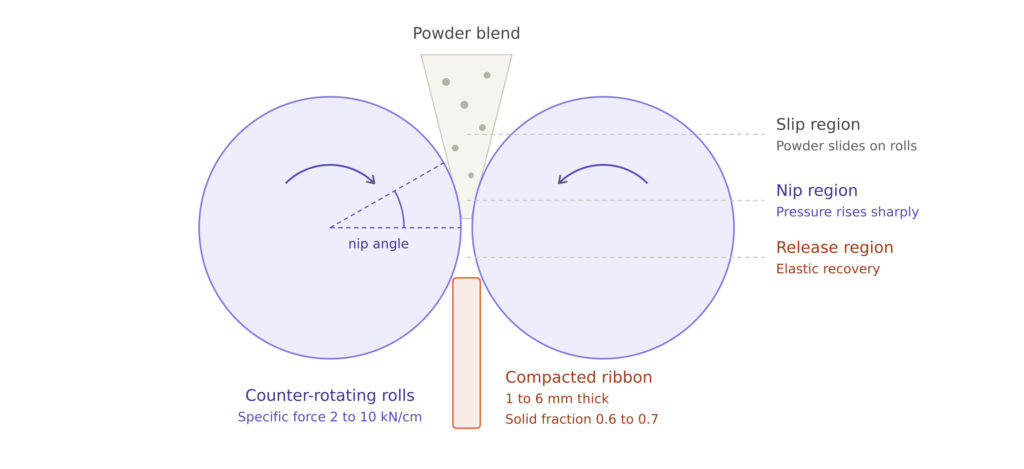
The nip is where compaction physically happens. As powder is drawn between the two counter-rotating rolls, it passes through three regions:
- Slip region: powder moves faster than the roll surface, minimal densification
- Nip region: powder and roll surface move together, and pressure rises sharply
- Release region: the compact expands slightly as it exits and elastic recovery occurs
The angle at which slip transitions to nip, known as the nip angle, is a function of the powder’s friction and compressibility properties. Johanson’s rolling theory, published in 1965, remains the foundational model for predicting it and is still used in modern scale-up work.
Stage 3: Ribbon formation
The output is a continuous ribbon, typically 1 to 6 mm thick. Ribbon quality is the single best predictor of final product quality, which is why it is treated as an intermediate critical quality attribute rather than a transient by-product.
Stage 4: Milling and sizing
The ribbon passes into an integrated granulator, usually an oscillating or rotary bar mill fitted with a screen. Screen aperture, rotor speed, rotor gap and the number of milling passes determine the resulting granule size distribution.
The unavoidable trade-off here is fines generation. Milling always produces a fraction of undersized material. Many production lines recirculate fines back into the feed hopper to protect yield, but recycled fines have already been compacted once, so an uncontrolled recycle loop introduces a material property drift that is easy to miss and difficult to diagnose.
Roller compaction vs wet granulation: which should you choose?
| Factor | Roller compaction (dry) | High shear wet granulation |
| Moisture exposure | None | High, requires drying |
| Heat exposure | Low, localised at nip | Moderate to high during drying |
| Process steps | Fewer, no drying stage | More, includes drying and sizing |
| Energy consumption | Lower | Higher, drying dominates |
| Solvent handling | Not required | Often required |
| Suitability for continuous manufacturing | Excellent | Moderate, drying is the bottleneck |
| Typical batch cycle time | Shorter | Longer |
| Risk of loss of tabletability | Significant | Lower |
| Granule strength and uniformity | Moderate, wider distribution | Generally higher and more uniform |
| Best fit | Moisture or heat sensitive APIs, high dose, effervescents | Poorly compressible APIs, low dose, high uniformity needs |
The short version: choose roller compaction when your molecule cannot tolerate water or heat, when you want to compress a manufacturing footprint, or when you are designing for continuous processing. Choose wet granulation when your API is poorly compressible and content uniformity at low dose is the dominant risk.
The critical process parameters that decide everything
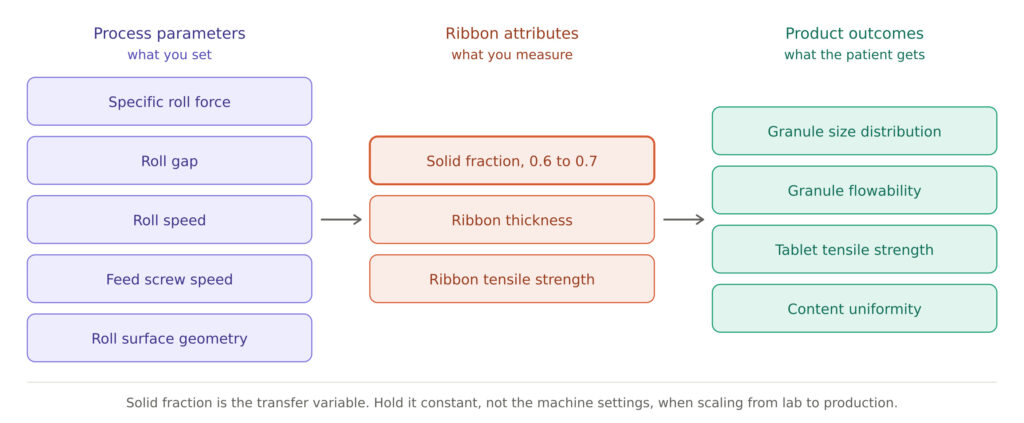
Roller compaction has relatively few adjustable parameters, which is deceptive. The interactions between them are strong and non-linear.
| Parameter | Typical range | What it controls |
| Specific roll force | 2 to 10 kN/cm, up to 20 in some units | Ribbon density and strength |
| Roll gap | 1 to 6 mm | Ribbon thickness, dwell time under pressure |
| Roll speed | 1 to 20 rpm | Throughput and residence time in the nip |
| Feed screw speed | Ratio-controlled to roll speed | Material supply to the nip, gap stability |
| Roll surface | Smooth, knurled, serrated, pocketed | Powder grip, slip behaviour, ribbon uniformity |
| Vacuum de-aeration | On or off, variable | Air removal, ribbon consistency |
| Mill screen aperture | 0.5 to 2.0 mm typical | Granule size distribution, fines fraction |
Why roll gap control matters more than most teams expect
There are two design philosophies. Fixed gap systems hold the rolls in a mechanically set position. Floating gap systems use hydraulic pressure to maintain constant force, allowing the gap to vary in response to feed fluctuations.
Most modern pharmaceutical units use a floating roll with closed-loop gap control, because it decouples the ribbon from feed variability. When feed rate dips, the gap narrows automatically and force is maintained. Without that, a feed disturbance becomes a ribbon density disturbance, and a ribbon density disturbance becomes a tablet hardness disturbance three unit operations later.
Roll surface: the most under-specified choice
Smooth rolls slip easily with cohesive powders and are usually the wrong default. Knurled and serrated surfaces grip better and are the common production choice. Pocketed rolls produce briquettes rather than a continuous ribbon and are typically used in chemical rather than pharmaceutical applications. If ribbon quality is inconsistent and the parameters look correct on paper, roll surface geometry is often the actual root cause.
Ribbon solid fraction: the number that matters most
Solid fraction is the ratio of ribbon density to the true density of the material. It expresses how much of the ribbon volume is solid material rather than void space.
For most pharmaceutical formulations, the target window is a solid fraction of roughly 0.6 to 0.7. Below that range, the ribbon is too weak, milling produces excessive fines, and flow improvement is marginal. Above it, you enter over-compaction territory.
Solid fraction is preferred over roll force as the control variable because it is a material property rather than a machine setting. A given solid fraction should be reproducible across machine scales, which makes it the anchor of any credible scale-up strategy.
Newer approaches go further. Equipment suppliers have developed in-line ribbon strength measurement on the basis that two ribbons at the same solid fraction can still yield different tablet strengths, meaning density alone does not fully capture ribbon behaviour.
Loss of tabletability: the counterintuitive failure mode
This is the most important concept in roller compaction and the one most often learned the expensive way.
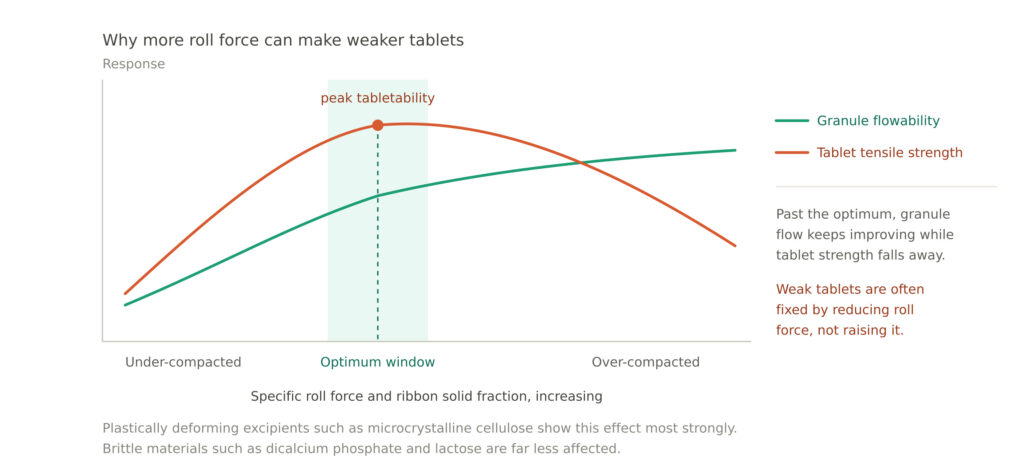
Loss of tabletability, also called work hardening or the granule hardening effect, means that granules produced at a higher roll force compress into weaker tablets than granules produced at a lower roll force.
The mechanism is straightforward once stated. Many pharmaceutical excipients, microcrystalline cellulose being the classic example, deform plastically. During compaction, that plastic deformation capacity is partly consumed. When the resulting granules reach the tablet press, less deformation potential remains, so fewer clean bonding surfaces form and tablet tensile strength falls.
The practical consequences:
- Tablet hardness problems are frequently solved by reducing roll force, not increasing it
- Every formulation has an optimum solid fraction beyond which tabletability declines
- Brittle materials such as dicalcium phosphate and lactose are far less affected than plastic ones
- Excipient selection and roll force must be developed together, never sequentially
Any development programme that optimises granule flow without simultaneously tracking downstream tablet tensile strength is measuring only half the process.
Common problems and how to diagnose them
| Symptom | Likely root cause | First corrective action |
| Ribbon splitting along the centre or edges | Non-uniform pressure across roll width, poor sealing | Check roll sealing system, reduce roll speed |
| Excessive fines after milling | Ribbon solid fraction too low | Increase roll force or narrow the gap |
| Weak tablets despite good granule flow | Loss of tabletability from over-compaction | Reduce roll force, re-map the solid fraction window |
| Fluctuating gap during a run | Inconsistent feed, entrained air | Enable or increase vacuum de-aeration, tune screw ratio |
| Powder leaking at roll edges | Worn or misaligned sealing system | Inspect cheek plates or rim seals |
| Batch-to-batch variability with identical settings | Incoming material property drift | Tighten input specifications, add PAT monitoring |
Types of pharmaceutical roller compactor configurations
By roll orientation: vertical, horizontal, and inclined feed arrangements. Vertical feed uses gravity to assist material delivery. Horizontal arrangements can offer better containment and cleaning access.
By sealing system: cheek plate sealing, where fixed side plates contain the powder, and rim sealing, where one roll has raised edges. Cheek plates are simpler; rim seals generally reduce edge leakage and side-to-side density variation.
By scale:
- Laboratory and R&D units: from a few hundred grams per hour, designed for small API quantities
- Pilot scale: tens of kilograms per hour, used for process characterisation and clinical batches
- Production scale: several hundred kilograms per hour and above
By containment level: high potency APIs demand containment to OEB 4 and OEB 5, achieved through isolators, split butterfly valves, wash-in-place systems and contained discharge. Containment is one of the largest cost differentiators in the equipment class.
Leading pharmaceutical roller compactor manufacturers
| Manufacturer | Country | Notable range |
| Gerteis | Switzerland | Mini-Pactor, Macro-Pactor, Pactor series |
| Alexanderwerk | Germany | WP series |
| Fitzpatrick (Hosokawa) | USA | Chilsonator and IR series |
| Freund-Vector | Japan / USA | TF series |
| L.B. Bohle | Germany | BRC series |
| Hosokawa Alpine | Germany / Japan | Bepex Pharmapaktor |
| Yenchen Machinery | Taiwan | Pharmaceutical dry granulation range |
| Prism Pharma Machinery | India | Roll compactor range |
| Cadmach | India | Pharmaceutical compaction equipment |
India and China have become significant supply bases for mid-tier and lab-scale units, while European and Japanese suppliers continue to dominate high containment and PAT-enabled production installations. For buyers in emerging markets, this creates a genuine two-tier procurement decision rather than a single global price point.
Market outlook: where roller compaction is heading
Market sizing for roller compactors is frequently misreported because the term also refers to construction soil compaction equipment. The pharma-relevant figures are narrower.
Analysts covering dry granulation specifically place the roller compactor segment at <cite index=”8-1″>roughly USD 193 million in 2025, forecast to reach approximately USD 288 million by 2034 at a compound annual growth rate of about 6.1 percent</cite>. An earlier assessment of the same segment put it at <cite index=”2-1″>about USD 187 million in 2023, growing to USD 267 million by 2030 at around 5 percent annually</cite>. Broader dry granulation equipment, which includes slugging machines, is estimated in the low billions.
Three forces are driving the growth:
1. Continuous manufacturing. Roller compaction is one of the few granulation technologies that is genuinely continuous by nature. There is no batch drying step to interrupt flow. <cite index=”15-1″>Its scalability, lower energy consumption and compatibility with continuous manufacturing make it the pivotal operation within dry granulation.</cite> ICH Q13, finalised as the international guideline on continuous manufacturing, has given regulatory clarity to companies that had been hesitant to commit capital.
2. PAT and real-time release. <cite index=”16-1″>ICH Q13 treats process analytical technology tools as integral to continuous manufacturing, since real-time monitoring is what establishes a state of control and supports continuous process verification.</cite> In roller compaction this means in-line NIR for ribbon density, in-line thickness measurement, and increasingly in-line ribbon strength measurement.
3. Modelling and machine learning. Research published in 2025 demonstrates <cite index=”15-1″>machine learning frameworks that predict ribbon thickness and density, identify feasible operating regions, and support closed-loop control and Quality by Design implementation in dry granulation</cite>. Ribbon splitting, historically diagnosed by experience, is now being addressed with predictive models.
4. Regional shift. Growth is concentrated in Asia-Pacific, where generics capacity continues to expand, while North American and European demand is weighted toward high containment and continuous line upgrades rather than volume additions.
Roller compactor buying checklist
Before issuing an RFQ, get clear answers on the following:
- Scalability path: can results from the lab unit transfer to production without reformulation? Ask specifically about roll diameter and roll width scaling ratios.
- Gap control method: floating roll with closed-loop control, or fixed gap?
- Roll surface options: are multiple geometries available and interchangeable?
- Sealing system: cheek plate or rim seal, and what is the documented edge leakage performance?
- De-aeration: is vacuum de-aeration standard or an option?
- Containment rating: what OEB level is achievable, and with what added equipment?
- PAT readiness: are ports and data interfaces available for NIR or thickness sensors?
- Cleaning: is it wash-in-place, or full disassembly? Estimate changeover hours realistically.
- Data integrity: does the control system meet 21 CFR Part 11 and EU Annex 11 requirements?
- Spare parts and service: what is the lead time for rolls and screens in your region?
Frequently asked questions
What is a roller compactor used for in pharma? A roller compactor is used for dry granulation. It converts fine, poorly flowing powder blends into dense granules with improved flow and bulk density, so they can be reliably compressed into tablets or filled into capsules. It is chosen when an API cannot tolerate the moisture or heat of wet granulation.
What is the difference between roller compaction and slugging? Both are dry granulation methods. Slugging uses a heavy duty tablet press to form large compacts that are then milled. Roller compaction is continuous, more efficient, easier to control, and produces more consistent compacts. Slugging is largely legacy technology retained for specific low-volume applications.
What is ribbon solid fraction and what should it be? Solid fraction is the ratio of ribbon density to the material’s true density. It is the primary critical quality attribute of roller compaction. Most pharmaceutical formulations target a solid fraction between 0.6 and 0.7, though the optimum is formulation specific and must be established experimentally.
Why do my tablets get weaker when I increase roll force? This is loss of tabletability. Higher compaction pressure consumes the plastic deformation capacity of the excipients during ribbon formation, leaving less available at the tablet press. The result is lower tablet tensile strength. Reducing roll force is often the correct fix.
Can roller compaction be used for high potency APIs? Yes. Contained roller compactors rated to OEB 4 and OEB 5 are available from most major suppliers, using isolators, split butterfly valve transfers, contained discharge and wash-in-place systems. Containment adds meaningfully to capital and operating cost.
Is roller compaction suitable for continuous manufacturing? Yes, and it is among the best-suited granulation technologies for it. Because dry granulation eliminates the drying step, there is no inherent batch interruption. Roller compaction features in most integrated continuous direct-to-tablet lines.
What throughput can a pharmaceutical roller compactor achieve? Laboratory units start in the range of a few hundred grams per hour. Pilot scale typically covers tens of kilograms per hour. Production machines commonly run from 100 to several hundred kilograms per hour depending on roll dimensions and formulation.
How do you scale up a roller compaction process? Scale-up is anchored on maintaining constant ribbon solid fraction rather than constant machine settings. Specific roll force in kN/cm normalises for roll width, and roll surface geometry should be held consistent. Johanson’s model and modern process models help predict the settings required at the larger scale.
The takeaway for pharma decision makers
Roller compaction looks mechanically simple. Two rolls, one gap, a mill. That simplicity conceals a process where a small change in feed screw speed can move tablet hardness out of specification, and where pushing harder produces a worse outcome.
For companies evaluating capital investment, the strategic question is no longer whether roller compaction works. It is whether the unit you buy today can carry PAT instrumentation, feed a continuous line, and handle the potency profile of the pipeline you will be running in five years. Buying for today’s molecule is the most common and most expensive mistake in this equipment category.
Explore more with Hello Pharma
Hello Pharma is a leading B2B platform for the pharmaceutical industry, engaging 140+ top pharma brands and 1,100+ companies across 120+ countries through tech-focussed content. It combines strategic intelligence with sharp go-to-market capabilities to connect businesses with the right country, right organizations, and right decision-makers, enabling high-value, outcome-driven conversations across the global pharma ecosystem.
- Pharma-tech portal: Hello-Pharma.com
- Listen to pharma leaders: Hello Pharma Explore, The Pharma Podcast
- Strategic intelligence and go-to-market: HelloIntel.Hello-Pharma.com
- Sector-specific marketing solutions: HelloPharmaMarketing.com
Manufacturing equipment suppliers looking to reach formulation scientists, process engineers and technical procurement teams across 120+ countries can explore Hello Pharma’s go-to-market capabilities.